Firstly, let me come clean – I am neither an architect nor an historian. I am, currently, a PhD student in Electrical Engineering with a background in Physics, so, if any of my posts lack the nuance one would get from somebody even remotely qualified to speak of history and architecture and the like, then I apologise. I will, however, do my very best to ensure that every post is as thoroughly well researched as I can. You lucky things.
Despite my current occupation with Electrical Engineering, I have always had a fascination with architecture. Indeed, it had been my original plan to study architecture at university – but, for reasons I shan’t go into here, I wound up studying for a degree in Physics instead. The love of architecture started early, I remember on trips around the centre of Glasgow with my dear old gran, she’d perpetually encourage me to stop and look up. As a small child, full of wonder for the world, the grand, Victorian buildings throughout Glasgow’s centre and west-end had me transfixed.
Architecture, as an art-form, is fascinating to me; beyond the aesthetics – which the grand buildings throughout Glasgow address with outstanding levels of opulence – there is the matter of it’s purpose. Does it seek to impose or blend in? Who is it for? What does it house? Where is it located? As a child, the first question was generally all that I managed to answer – it was the former – and, don’t get me wrong, aesthetics are important, but there was so much I didn’t look at until much, much later. There’s also a more important question, in my opinion; what story does the building tell?

My proper fascination with the stories told by buildings started in the building pictured above – the Kelvin Building at the University of Glasgow (there are a few stories associated with this place, but I’ll save them for later!).
The interest was sparked in a lecture on Positional Astronomy; half way through a discussion on celestial coordinate systems, our lecturer digressed somewhat to discuss the various observatories that the city had known through the years. This was usual, a small five minute diversion mid-way to keep our attention… but this time it evolved a little more into a (very interesting) rant. The first University Observatory had been out on High Street, near the Cathedral. Near where the University was first situated.
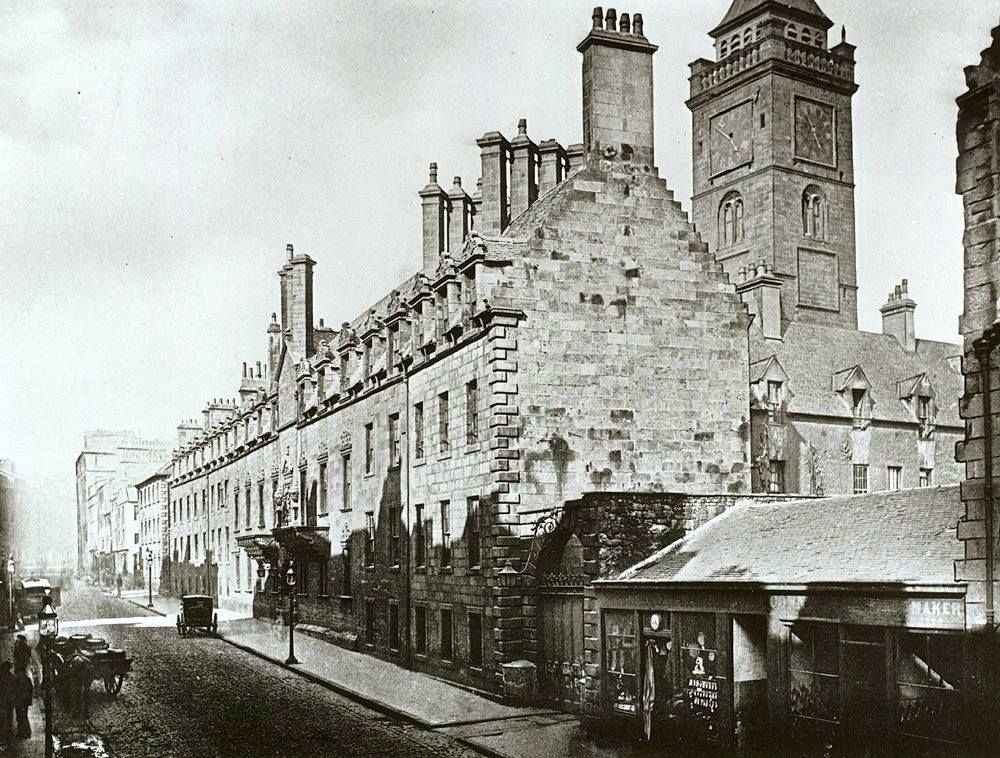
Looking at it’s Gothic (revival) style, its spires, vaulted cloisters, turrets, and Hogwarts-esque quadrangles, one would be forgiven for imagining that the University had always been situated at Gilmorehill. However, between 1460 and 1870, it was situated on High Street. The previous campus having been constructed in the mid-1600s. Our lecturer told us of how the University, seeking to move to the more desirable west-end, sold the land on High Street to the railways, moving out in 1870. He concluded by telling us that the 17th century buildings were demolished by the railways in, what has been described by some as, the greatest act of “cultural vandalism” in Scottish history.
The remainder of the lecture had me fascinated with the idea that such an important piece of Glasgow’s cultural heritage had simply been torn down. I knew that there were a lot of “old buildings” in Glasgow but, by comparison, they were fairly modern. I was captivated by this idea of trying to find out how much of Old Glasgow really remained, and why had it changed so much? Of course, I was meant to be paying attention to the lecture by that point, but that ship had sailed… I never did fully understand celestial coordinates and much of that course has rather fallen out of my head by now. But, take heart, Declan, you got me interested in something equally fascinating that day!
Throughout the rest of this blog, I hope to take you on a journey through the history of our Dear Green Place, exploring the buildings and places that have come and gone, and the stories they tell about Glasgow and its place in the wider world! Along the way, feel free to ask questions and if you’ve any extra knowledge, I’d love to hear it!
 Glasgow Then and Now